
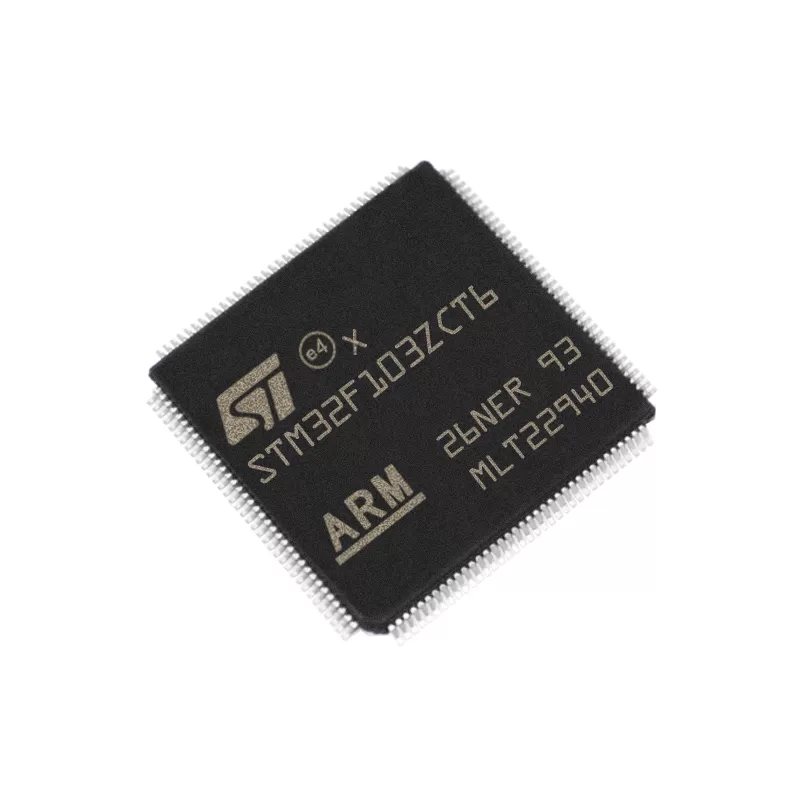
STMicroelectronics ships over 10 billion STM32 microcontrollers annually — making it the most widely deployed 32-bit MCU family on the planet. But that dominance comes with consequences for buyers: STM32 allocation cycles have been a persistent fact of life since 2021, and popular families like the STM32F103, STM32F407, and STM32H743 still routinely hit 20–40 week lead times. This guide maps the ST portfolio, explains where the bottlenecks are, and shows how to secure genuine ST components without falling into gray-market traps.
STMicroelectronics: Core Product Families at a Glance
| Series | Category | Typical Applications | Availability Outlook |
|---|---|---|---|
| STM32F1 / STM32F4 | Cortex-M3/M4 Mainstream MCUs | Motor drives, industrial control, IoT gateways, consumer | Tight; 20–40 weeks |
| STM32H7 | Cortex-M7 High-Performance MCUs | Edge AI, real-time DSP, high-speed data acquisition | Very tight; 30–50 weeks |
| STM32L0 / STM32L4 / STM32L5 | Ultra-Low-Power Cortex-M MCUs | Battery sensors, medical wearables, smart meters | Improving; 16–30 weeks |
| STP / STW / STL | Power MOSFETs (N-Ch, P-Ch, Super-Junction) | SMPS, motor drives, DC-DC, automotive | Tight; 20–40 weeks |
| STTH / STPS | Power Schottky & Ultrafast Diodes | PFC, rectification, freewheeling, snubber | Moderate; 12–26 weeks |
| L7980 / L5963 / VIPER | DC-DC Converters & Offline Converters | Industrial power supplies, auxiliary rails | Stable; 10–20 weeks |
| VN / L99 | Automotive Smart Power & Motor Drivers | Body electronics, HVAC, pumps, mirror control | Tight; 26–40 weeks |
The STM32 Allocation Problem: Why It Hasn't Gone Away
STMicroelectronics invested heavily in 300 mm wafer capacity at its Crolles and Agrate fabs, but demand growth — driven by industrial automation, EV adoption, and IoT proliferation — has outpaced supply. Three dynamics keep the pressure on:
1. Pin-to-pin ecosystem lock-in. The STM32 platform's dominance means millions of PCB designs are dependent on specific STM32 part numbers. Redesigning a board to accept an alternative MCU (GigaDevice, Nuvoton, NXP) costs 6–12 months of engineering time and often requires firmware porting — a non-trivial investment that many OEMs cannot absorb mid-cycle.
2. Automotive priority allocation. ST's automotive customers (Tier-1s and OEMs) receive priority on wafer output via long-term supply agreements. Industrial and consumer buyers — even those with strong volume forecasts — are second in line when allocation tightens.
3. Gray market counterfeits proliferate during shortages. The STM32F103C8T6 — affectionately called the "Blue Pill" MCU — is one of the most counterfeited semiconductors in the world. During allocation windows, gray-market sellers flood platforms with remarked, reballed, or outright fake STM32s. Procurement teams without a vetted supply chain face significant counterfeit risk.
How ADD Components Sources STMicroelectronics Components
ADD Components maintains direct relationships with authorized ST distribution channels across Asia-Pacific, giving our procurement teams access to inventory pools that single-region distributors cannot reach. When STM32F407VGT6 shows zero stock in Europe but is available in Singapore, our multi-region sourcing network finds it.
For allocation-affected STM32 families, our engineering team cross-references against functionally compatible alternatives — including pin-compatible GigaDevice GD32 and Nuvoton M4 series parts — within 48 hours. When cross-referencing isn't viable, we source genuine ST components from verified global inventory and ship with full documentation: Certificate of Conformance, date-code verification, digital microscopy inspection, and XRF analysis for RoHS compliance.
We warehouse popular ST discretes (STP MOSFETs, STTH diodes) and STM32 development ecosystem parts across Hong Kong, Shenzhen, and Singapore, enabling 5–7 day DDP delivery to most industrial destinations.