
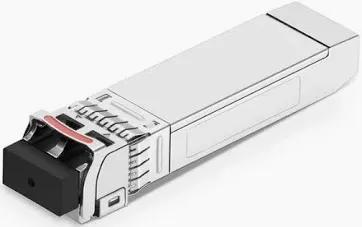
Complete SFP28 25G optical transceiver guide covering all variants: SR (850 nm MMF, 70 m OM3/100 m OM4), LR (1310 nm SMF, 10 km), eLR (25 km), ER (40 km), BiDi single-fiber, and 25G CPRI/eCPRI for 5G fronthaul. Industrial temperature (–40 to +85 °C), SFP+ backward compatible. Pre-coded for Cisco, Arista, Juniper, Nokia, Ericsson. ADD Components Hong Kong.
SFP28 Transceiver: The Complete Guide to 25G Pluggable Optics
The SFP28 transceiver is the 25 Gbps member of the SFP form-factor family, delivering a 2.5× speed increase over SFP+ while retaining the same physical footprint and LC connector interface. Defined by the IEEE 802.3by (25GBASE-SR) and 802.3cc (25GBASE-LR, 25GBASE-ER) standards, SFP28 has become the dominant server-to-ToR (top-of-rack) interface in cloud and enterprise data centers, replacing 10G SFP+ in new builds. Critically, SFP28 is also the optical interface of choice for 5G NR fronthaul — carrying 25 Gbps CPRI/eCPRI traffic between distributed units (DUs) and radio units (RUs) in C-RAN and O-RAN architectures. With industrial-temperature variants rated for –40 to +85 °C, backward compatibility with SFP+ cages, and a growing installed base measured in the tens of millions of ports, SFP28 represents the most significant post-10G pluggable optics platform in the industry.
All SFP28 Variants: Specification Comparison
The SFP28 ecosystem spans four primary Ethernet variants plus CPRI/eCPRI modules for 5G fronthaul. The table below captures all commercially deployed SFP28 transceiver types.
| Variant | IEEE Standard | Speed | Wavelength | Fiber | Max Reach | TX Power (dBm) | RX Sensitivity (dBm) |
|---|---|---|---|---|---|---|---|
| SR | 25GBASE-SR (802.3by) | 25.78125 Gbps | 850 nm (VCSEL) | MMF (OM3/OM4/OM5) | 70 m (OM3); 100 m (OM4/OM5) | –8.4 to +2.4 | –10.3 |
| LR | 25GBASE-LR (802.3cc) | 25.78125 Gbps | 1310 nm (DFB) | SMF (OS1/OS2) | 10 km | –7 to +2 | –13.3 |
| eLR | Proprietary extended-reach | 25.78125 Gbps | 1310 nm (DFB, higher power) | SMF (OS1/OS2) | 25 km | –2 to +4 | –18 (APD) |
| ER | 25GBASE-ER (802.3cc) | 25.78125 Gbps | 1310 nm or 1550 nm (cooled EML) | SMF (OS1/OS2) | 30–40 km | –2.9 to +4.5 | –20.5 (APD) |
| BiDi | Proprietary 25G-BiDi | 25.78125 Gbps | TX 1270 / RX 1330 nm (paired) | SMF (single strand) | 10–25 km | –5 to +2 | –14 (10 km); –18 (25 km) |
| 25G CPRI / eCPRI | CPRI v7.0 / O-RAN Fronthaul | 24.33024 Gbps (Option 10) | 1310 nm (DFB) | SMF | 10–20 km | –7 to +2 | –13.3 (PIN); –18 (APD) |
25GBASE-SR: Data Center Server-to-ToR Dominant
25GBASE-SR, standardized in IEEE 802.3by (2016), uses an 850 nm VCSEL to achieve 25.78125 Gbps over multi-mode fiber — precisely the line rate required to carry a 25 GbE MAC frame with 64B/66B encoding and RS-FEC (Reed-Solomon Forward Error Correction, RS(528,514)). The inclusion of RS-FEC at the physical layer is a fundamental departure from 10GBASE-SR: it adds approximately 100 ns of latency but provides approximately 5 dB of coding gain, enabling reliable 25 Gbps transmission over the same OM3/OM4 fiber plant that previously carried 10G SR at 300–400 meters. The reach trade-off is significant: 70 meters on OM3 and 100 meters on OM4/OM5, a reduction from 10G SR's 300/400 meters, driven by the higher 25.78 Gbaud symbol rate and tighter signal-to-noise requirements. Within a data center, 70–100 meters covers virtually all server-to-ToR switch connections and most ToR-to-leaf links, making SR the default choice for intra-rack and adjacent-rack 25G connectivity. SFP28 SR modules consume under 1.5 W and are priced at roughly 1.5× the cost of 10G SFP+ SR — a modest premium for 2.5× the throughput.
25GBASE-LR: 10 km Single-Mode for Campus and Fronthaul
25GBASE-LR, standardized in IEEE 802.3cc (2017), operates at 1310 nm with a directly modulated DFB laser and achieves 10 km reach on OS2 single-mode fiber with approximately 6.3 dB of link budget. The RS-FEC engine provides coding gain that compensates for the higher modulation rate relative to 10GBASE-LR, maintaining the same 10 km reach despite the 2.5× increase in symbol rate. This is the go-to SFP28 variant for campus inter-building links, metro access, and distributed 5G fronthaul architectures where centralized baseband units (or distributed units) connect to remote radio units over single-mode fiber spans up to 10 km. In 5G C-RAN (Centralized RAN) deployments, a single DU may serve 6–12 RUs, each connected via a dedicated 25G LR SFP28 link — creating aggregate optics demand that rivals data center server connectivity in scale.
eLR and ER: Extended-Reach SFP28 for Metro and Rural 5G
For deployments where 10 km is insufficient, the proprietary 25G eLR variant extends reach to 25 km using a higher-power 1310 nm DFB laser (–2 to +4 dBm) paired with an APD receiver (–18 dBm sensitivity), yielding a link budget of approximately 16 dB. This is particularly relevant for rural 5G macro-cell deployments where cell-site spacing exceeds 10 km and the DU-to-RU fiber span must bridge longer distances without intermediate active equipment. At 25 km on G.652 fiber, 1310 nm operation ensures near-zero chromatic dispersion, so dispersion-induced eye closure is negligible — the limiting factor is purely attenuation. The IEEE 802.3cc 25GBASE-ER standard defines 30–40 km reach using either 1310 nm or 1550 nm cooled EML transmitters with APD receivers; in practice, the commercially dominant eLR variant at 20–25 km has proven sufficient for the vast majority of carrier fronthaul and metro-access applications, with full ER modules reserved for exceptional long-span requirements.
BiDi SFP28: Single-Fiber Conservation for Fronthaul and Access
The 25G BiDi SFP28 transceiver transmits and receives over a single strand of single-mode fiber, using internal WDM filters to separate 1270 nm (upstream) and 1330 nm (downstream) wavelengths. Deployed as matched pairs, BiDi modules halve the fiber count required for full-duplex 25G links — a critical advantage in 5G fronthaul where dark fiber availability at cell sites is often the binding constraint on deployment schedules. A typical macro-cell site with three sectors and 2×2 MIMO may require 6–12 fiber strands for CPRI/eCPRI fronthaul; BiDi SFP28 modules reduce this to 3–6 strands, potentially avoiding the cost and delay of pulling new fiber. BiDi reach options include 10 km (PIN receiver) and 25 km (APD receiver), covering urban macro-cell and suburban/rural deployment scenarios respectively.
The Backward-Compatibility Advantage: SFP28 in SFP+ Cages
One of the most compelling features of SFP28 is its electrical and mechanical backward compatibility with SFP+ ports. An SFP28 module fits into any SFP+ cage, and the host device — provided its SERDES supports 25 Gbps NRZ signaling — can operate the module at its full 25G line rate. This means that switch platforms with SFP28-capable ASICs (such as Broadcom Tomahawk 2/3, Trident 3, or Jericho2) can populate SFP+ form-factor ports with SFP28 modules, achieving a 2.5× capacity upgrade without replacing switch hardware or re-cabling. In practice, this has enabled a smooth, incremental migration from 10G to 25G in data centers: operators replace 10G SFP+ SR modules with 25G SFP28 SR modules in the same cages, on the same OM3/OM4 fiber plant, and achieve 25G server-to-ToR throughput with zero infrastructure changes beyond the optics themselves. Conversely, an SFP28 port will also accept an SFP+ module operating at 10G, providing full forward and backward interoperability. This seamless upgrade path — unique to the SFP/SFP+/SFP28 family — is a major reason why SFP28 adoption has accelerated faster than any prior speed transition in the pluggable optics market.
5G Fronthaul: SFP28 as the eCPRI/CPRI Interface Standard
The 5G radio access network has made SFP28 the dominant optical interface for fronthaul — the link between distributed units (DUs) and radio units (RUs). In an O-RAN split 7.2 architecture, 25 Gbps eCPRI SFP28 modules carry digitized IQ samples, beamforming coefficients, and control-plane traffic between the DU pool and remote radio heads. The line rate — 25.78125 Gbps for Ethernet-based eCPRI, or 24.33024 Gbps for CPRI Option 10 — provides sufficient capacity for a single 100 MHz NR carrier with 64T64R massive MIMO antenna configuration. For higher-capacity radio configurations, multiple SFP28 links are bonded at the DU side.
Fronthaul SFP28 modules must meet requirements that go beyond standard Ethernet optics:
Industrial Temperature (–40 to +85 °C): Outdoor RU enclosures experience extreme thermal cycling. Industrial-temp SFP28 modules use hermetically sealed TO-can lasers, temperature-compensated bias circuits, and extended burn-in to ensure stable optical output across the full –40 to +85 °C range.
Strict Latency: eCPRI fronthaul requires round-trip latency under 100 µs (for split 7.2) to maintain air-interface timing. SFP28 modules add less than 1 µs of optical transit time plus RS-FEC encoding delay (~100 ns), well within budget.
Low Jitter: CPRI links carry synchronization information embedded in the data stream. RMS jitter must remain under 0.5 ps to prevent clock-recovery instability at the RU.
Hardened Packaging: Fronthaul SFP28 modules used in outdoor RUs are often specified with IP-65/IP-67 rated optical connector boots to prevent moisture ingress, and may incorporate extended ESD protection for exposed antenna-site environments.
Procurement: Volume, Quality, and Platform Compatibility
The SFP28 market is bifurcated between data center and carrier fronthaul segments, each with distinct procurement dynamics. Data center SR and LR modules are high-volume, cost-sensitive commodities where price-per-unit and MSA compliance are the primary selection criteria; carrier fronthaul modules demand industrial-temperature rating, rigorous lot-level test documentation, and long-lifecycle supply commitments (5–7 years to match the depreciation cycle of RAN infrastructure). Platform compatibility is non-negotiable in both segments: SFP28 modules must be pre-coded for the target switch or router vendor (Cisco Nexus/MDS, Arista, Juniper, HPE, Dell, Nokia, Ericsson, Huawei) with the correct vendor ID, part number, and checksum to enable plug-and-play recognition without requiring "unsupported-transceiver" configuration workarounds. ADD Components supplies SFP28 modules across all variants — SR, LR, eLR, BiDi, CPRI/eCPRI — with full MSA compliance, SFF-8472 DDM telemetry, industrial-temperature options, and pre-coding for every major platform vendor.
Last updated on July 08, 2026