
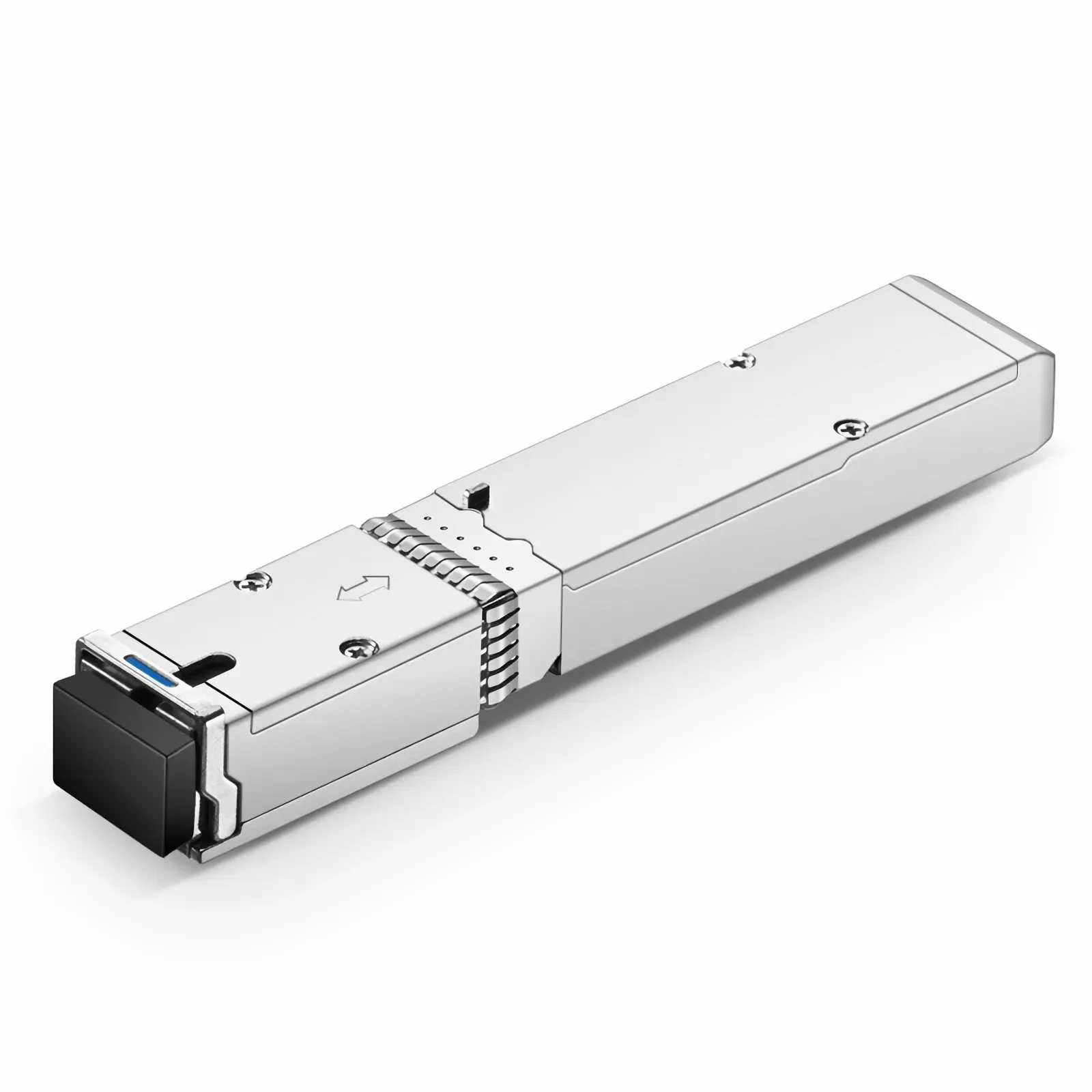
SFP-DD (Double Density) transceiver portfolio: 25G fallback, 50G SR/LR (2×25G NRZ), and 100G SR/LR (2×50G PAM4). Physically backward compatible with SFP+/SFP28 cages. Twice the faceplate density of QSFP28 for 50G/100G server access. ADD Components Hong Kong — full SFP-DD range, pre-coded for all major platforms.
SFP-DD Optical Transceiver: Double-Density Pluggable for 50G/100G Server Access
The SFP-DD (Small Form-Factor Pluggable Double Density) is a next-generation pluggable transceiver form factor that doubles the electrical lane count of the traditional SFP from one to two, enabling 50 Gbps and 100 Gbps operation in the same physical footprint as the ubiquitous SFP+/SFP28 cage. Developed by the SFP-DD MSA and adopted by hyperscale data centre operators, SFP-DD delivers twice the faceplate bandwidth density of QSFP-based alternatives for server access, while maintaining full mechanical backward compatibility with the billions of deployed SFP/SFP+/SFP28 ports worldwide. ADD Components supplies the complete SFP-DD transceiver range, pre-coded for all major switch and NIC platforms.
Understanding SFP-DD: Architecture and Electrical Interface
The defining characteristic of SFP-DD is the addition of a second electrical lane to the SFP connector interface. Where the traditional SFP, SFP+, and SFP28 utilise a single transmit/receive pair — limiting the form factor to a maximum of 25 Gbps NRZ or 50 Gbps PAM4 — SFP-DD introduces a second high-speed differential pair accessible through additional contacts integrated into the existing SFP cage connector. This enables two independent 25 Gbps NRZ lanes (50 Gbps aggregate) or two 50 Gbps PAM4 lanes (100 Gbps aggregate) while preserving the exact physical dimensions of the SFP package.
The backward-compatibility story is central to SFP-DD's value proposition. A SFP-DD module inserted into a standard SFP+ or SFP28 cage functions as a single-lane device, falling back to 25G NRZ (or 10G in an SFP+ port). When inserted into a SFP-DD host port with the additional contacts engaged, both lanes are active and the module operates at its full rated speed. This dual-mode behaviour allows data centre operators to deploy SFP-DD optics today in existing SFP28 infrastructure and unlock the 50G/100G speed upgrade when SFP-DD-capable switching hardware is deployed — a forward-looking refresh strategy that protects the transceiver investment.
SFP-DD Variants: Complete Product Portfolio
| Variant | Data Rate | Lane Configuration | Wavelength | Reach | Fibre / Connector | Technology |
|---|---|---|---|---|---|---|
| 25G SR (single-lane fallback) | 25 Gbps | 1×25G NRZ | 850 nm | 70 m (OM3) / 100 m (OM4) | MMF / Duplex LC | VCSEL + PIN |
| 50G SR | 50 Gbps | 2×25G NRZ | 850 nm | 70 m (OM3) / 100 m (OM4) | MMF / Duplex LC | 2× VCSEL (parallel MMF) |
| 50G LR | 50 Gbps | 2×25G NRZ | 1310 nm | 10 km | SMF / Duplex LC | 2× DFB + PIN, CWDM |
| 100G SR | 100 Gbps | 2×50G PAM4 | 850 nm | 60 m (OM3) / 100 m (OM4) | MMF / Duplex LC | 2× 50G PAM4 VCSEL + DSP |
| 100G LR | 100 Gbps | 2×50G PAM4 | 1310 nm | 10 km | SMF / Duplex LC | 2× 50G PAM4 EML + DSP, CWDM |
25G Fallback Mode
When operated in a standard SFP28 cage, all SFP-DD modules default to single-lane 25G NRZ operation. This serves as the baseline compatibility tier — identical in function to a standard SFP28 25G SR or LR transceiver — and ensures SFP-DD modules can be deployed immediately in existing 25G server access infrastructure without waiting for SFP-DD host port availability.
50G SFP-DD: The 2×25G NRZ Sweet Spot
The 50G SFP-DD variant aggregates two 25.78125 Gbps NRZ lanes onto a single duplex fibre pair. In the SR (multimode) variant, two independent 850 nm VCSELs are optically combined within the module; in the LR (single-mode) variant, two 1310 nm-band DFB lasers at distinct CWDM wavelengths (typically 1271 nm and 1331 nm) are multiplexed onto a single fibre. The 50G SFP-DD provides a critical stepping stone between 25G and 100G server access, delivering double the throughput of 25G SFP28 in the same physical density. This makes it particularly attractive for hyperscale operators deploying 50G server NICs in AI/ML training clusters where GPU-to-ToR bandwidth must scale aggressively.
100G SFP-DD: Two Lanes of 50G PAM4
The 100G SFP-DD represents the upper bound of what the form factor can achieve, modulating two 53.125 Gbps PAM4 lanes onto a duplex fibre pair. Each lane carries 50 Gbps of payload after FEC and encoding overhead. The transmitter path requires an integrated DSP to handle PAM4 pre-emphasis and non-linearity compensation; the receiver incorporates DSP-based equalisation and clock-and-data recovery (CDR) to close the link budget at the target reach. The 100G SR variant achieves 60 metres on OM3 and 100 metres on OM4 using dual 850 nm VCSELs, while the 100G LR variant leverages two 1310 nm EMLs at CWDM wavelengths to reach 10 km on single-mode fibre.
SFP-DD vs. Competing Form Factors
| Parameter | SFP-DD | SFP56 | DSFP |
|---|---|---|---|
| Electrical Lanes | 2 | 1 (50G PAM4) | 2 |
| Max Data Rate | 100 Gbps (2×50G PAM4) | 50 Gbps (1×50G PAM4) | 100 Gbps (2×50G PAM4) |
| SFP/SFP+ Cage Compatible | Yes (single-lane fallback) | Yes (native) | No (different connector) |
| Backward Compatible with SFP28 | Yes | Yes | No |
| Faceplate Density Advantage | 2× vs QSFP28 for 50G/100G | 4× vs QSFP28 for 50G | 2× vs QSFP28 for 100G |
| MSA | SFP-DD MSA | SFP56 (SFP28 MSA extension) | DSFP MSA |
SFP-DD's primary competitive advantage over SFP56 is the path to 100G — a single-lane 50G PAM4 SFP56 module cannot deliver 100G, while SFP-DD's dual-lane architecture scales from 25G to 50G to 100G within the same basic design. Against DSFP, SFP-DD holds the decisive advantage of mechanical backward compatibility with the installed base of SFP/SFP+/SFP28 cages, which DSFP — with its different connector — cannot claim.
Applications
Hyperscale 50G/100G Server Access: The primary deployment scenario: connecting 50G or 100G server NICs to ToR switches at twice the port density achievable with QSFP28-based solutions. In a 1U ToR switch, SFP-DD enables up to 48 ports of 100G, versus a maximum of 24 QSFP28 100G ports in the same chassis height.
AI/ML Training Cluster East-West Links: GPU servers in distributed training clusters demand high-bandwidth, low-latency interconnect to the leaf switches. SFP-DD 50G SR provides a cost-optimised solution for GPU-to-ToR links where the bandwidth-per-GPU ratio does not warrant 100G or 200G QSFP-based optics.
Storage Fabrics: NVMe-oF and high-performance iSCSI storage targets benefit from SFP-DD's high port density, enabling more storage nodes per rack switch without requiring QSFP28 break-out cabling.
Forward-Looking Refresh: Operators deploying 25G SFP28 today can standardise on SFP-DD optics now, operating them in single-lane 25G mode, and unlock 50G or 100G when SFP-DD-capable switches are installed — zero transceiver replacement required.
Procurement Guidance
Host Port Compatibility: SFP-DD modules require SFP-DD host ports for dual-lane operation. Verify that the target switch or NIC supports the SFP-DD electrical interface; standard SFP28 ports will operate SFP-DD modules at single-lane 25G only.
Fibre Infrastructure: 50G/100G SR variants require OM4 multimode fibre for the full 100-metre reach. Existing OM3 cabling supports 60–70 metres depending on the data rate — adequate for most same-row ToR deployments but may fall short in end-of-row or middle-of-row architectures.
Power and Thermal: SFP-DD modules draw approximately 1.5–2.5 W at 50G and 3.0–4.5 W at 100G (PAM4), higher than the sub-1 W draw of SFP28 due to dual-lane operation and on-board DSP. Factor this into switch thermal budgets, particularly for 48-port configurations.
Multi-Sourcing: As a relatively newer MSA, SFP-DD has fewer qualified ODM sources than mature SFP28. ADD Components maintains multi-vendor supply agreements to ensure availability and competitive pricing across the full SFP-DD product range.
SFP-DD represents the logical evolution of the SFP form factor into the 50G/100G era, preserving the compact footprint and backward compatibility that made SFP the most successful pluggable optics standard in history while doubling its electrical capacity. For hyperscale data centre operators building the next generation of high-density server access infrastructure, SFP-DD is the form factor that balances port density, cost, and investment protection.
Last updated on July 08, 2026