
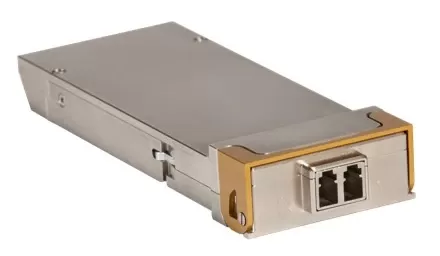
Complete CFP2 transceiver portfolio: 100GBASE-LR4 (10km), 100GBASE-ER4 (40km), 200G LR4, and CFP2-DCO coherent optics (100G DP-QPSK, 200G DP-16QAM) for metro DWDM and DCI. Only pluggable form factor supporting coherent DWDM at 100G/200G. ADD Components Hong Kong — full CFP2 range pre-coded for all major platforms.
CFP2 Optical Transceiver: Pluggable Coherent Optics for Metro DWDM Transport
The CFP2 (C Form-Factor Pluggable, generation 2) represents a unique category in the optical transceiver landscape: a pluggable module half the size of the original CFP that bridges the gap between client-side optics and line-side coherent DWDM transport. Unlike its QSFP28 and SFP28 contemporaries, CFP2 is the only pluggable form factor to deliver coherent optical engines — enabling 100G and 200G metro/regional DWDM connectivity in a field-replaceable module without dedicated line cards. ADD Components supplies the full CFP2 portfolio from 100GBASE-LR4 client optics through to CFP2-DCO coherent solutions for service provider metro and data centre interconnect applications.
CFP2 Form Factor Overview
Introduced by the CFP MSA as the successor to the original CFP (which measured 82 mm × 145 mm × 13.6 mm), CFP2 reduces the mechanical footprint by roughly 50% to approximately 106 mm × 41.5 mm × 12.4 mm while retaining the same high-power thermal envelope — up to 12 W in early specifications and extended to 18 W in later revisions. The electrical interface utilises a 104-pin connector supporting 10 × 10 Gbps, 4 × 25 Gbps, or 4 × 50 Gbps (PAM4) electrical lanes, giving CFP2 a total electrical capacity of up to 200 Gbps. This combination of substantial power headroom and flexible electrical lane configurations is what makes CFP2 uniquely suited to coherent optics, where on-board DSP and tunable laser assemblies demand 9–15 W of power that smaller form factors cannot thermally sustain.
The CFP2 portfolio spans three distinct product categories: standard client-side 100G transceivers for grey (uncoloured) single-mode links, 200G client-side modules for high-density aggregation, and — critically — CFP2-DCO (Digital Coherent Optics) modules that integrate a full coherent DSP, tunable laser, and modulator/demodulator chain for metro and regional DWDM transport over distances from 80 km to 1,000+ km.
Variant Overview: Complete CFP2 Portfolio
| Variant | Data Rate | Reach | Wavelength | Fibre / Connector | Key Technology |
|---|---|---|---|---|---|
| CFP2 100GBASE-LR4 | 100 Gbps (4×25G) | 10 km | 4× LAN-WDM (1295–1310 nm) | Duplex SMF / LC | 4× DFB, LAN-WDM MUX/DEMUX |
| CFP2 100GBASE-ER4 | 100 Gbps (4×25G) | 40 km | 4× LAN-WDM (1295–1310 nm) | Duplex SMF / LC | 4× EML or DFB + APD receiver, FEC |
| CFP2 100G ZR4 | 100 Gbps (4×25G) | 80 km | 4× LAN-WDM (1295–1310 nm) | Duplex SMF / LC | EML + APD, higher launch power, enhanced FEC |
| CFP2 200G LR4 | 200 Gbps (4×50G PAM4) | 10 km | 4× LAN-WDM (1295–1310 nm) | Duplex SMF / LC | 4× 50G PAM4 EML, DSP-based receiver |
| CFP2-DCO (100G DP-QPSK) | 100 Gbps coherent | 200–1,000+ km | C-band tunable (~1528–1566 nm) | Duplex SMF / LC | DP-QPSK modulation, coherent DSP, tunable laser |
| CFP2-DCO (200G 16QAM) | 200 Gbps coherent | 80–500 km | C-band tunable (~1528–1566 nm) | Duplex SMF / LC | DP-16QAM modulation, coherent DSP, tunable laser |
Client-Side CFP2: 100G and 200G Grey Optics
CFP2 100GBASE-LR4 (10 km)
The CFP2 100GBASE-LR4 is the entry-level CFP2 client optic, delivering 100 Gbps aggregate capacity over 10 km of single-mode fibre using four 25.78125 Gbps NRZ lanes multiplexed onto a single fibre pair via LAN-WDM. The optical architecture is identical in principle to the QSFP28 LR4 — four DFB lasers at 1295.56/1300.05/1304.58/1309.14 nm combined through an integrated MUX — but the larger CFP2 mechanical envelope provides superior thermal dissipation, making it the preferred choice for platforms where sustained operation in high-temperature environments or fanless edge equipment is required.
CFP2 100GBASE-ER4 (40 km)
For links exceeding the 10 km limit of LR4, the CFP2 100GBASE-ER4 extends reach to 40 km on standard G.652 single-mode fibre. This is achieved through higher-performance EML (electro-absorption modulated laser) transmitters with increased launch power, paired with APD (avalanche photodiode) receivers that provide 3–5 dB of additional sensitivity margin over PIN photodiodes. The ER4 variant also typically incorporates forward error correction (FEC) to maintain post-FEC bit-error rates below 1E-15 across the extended link budget. ER4 modules are commonly deployed in metro carrier rings, mobile backhaul aggregation, and DCI links spanning multiple central offices.
CFP2 200G LR4 (10 km)
Representing the transition to PAM4 modulation, the CFP2 200G LR4 modulates four 50 Gbps PAM4 electrical lanes onto four LAN-WDM optical carriers, achieving 200 Gbps aggregate throughput on the same duplex single-mode infrastructure. The move from NRZ to PAM4 effectively doubles spectral efficiency but imposes tighter signal-to-noise ratio requirements, necessitating on-module DSP (digital signal processing) for both transmitter pre-emphasis and receiver equalisation. CFP2 200G LR4 is positioned as a capacity-doubling upgrade path for existing 100G metro links where the dark fibre plant is fully utilised and adding new fibre pairs is cost-prohibitive.
CFP2-DCO: Pluggable Coherent Optics for DWDM Transport
The defining differentiator of the CFP2 form factor is its support for Digital Coherent Optics (DCO). A CFP2-DCO module integrates, within a single pluggable housing, the complete coherent optical engine: a narrow-linewidth tunable laser covering the full C-band ITU-T grid (~1528–1566 nm), a dual-polarisation IQ modulator, an integrated coherent receiver with local oscillator, and a 7 nm or 16 nm DSP ASIC that handles all digital signal processing functions — chromatic dispersion compensation, polarisation mode dispersion (PMD) equalisation, carrier frequency and phase recovery, and soft-decision FEC encoding/decoding.
CFP2-DCO modules are available in two primary modulation configurations:
100G DP-QPSK: Dual-polarisation quadrature phase-shift keying delivers 100 Gbps coherent line rate with exceptional optical signal-to-noise ratio (OSNR) tolerance, enabling reaches of 1,000 km or more in amplified DWDM systems. This is the standard for metro/regional core transport and long-haul service provider networks.
200G DP-16QAM: Dual-polarisation 16-state quadrature amplitude modulation doubles the spectral efficiency to 200 Gbps per wavelength. The trade-off is reduced OSNR tolerance, limiting practical reach to approximately 80–500 km in amplified systems. 16QAM is the preferred mode for metro DCI and high-capacity regional rings where reach requirements are moderate but per-fibre capacity must be maximised.
The key architectural advantage of CFP2-DCO is the elimination of the traditional bookended transponder/muxponder shelf. By plugging the coherent optic directly into the router or switch line card, service providers and cloud operators collapse two network layers into one — a concept known as IP-over-DWDM (IPoDWDM) — reducing capital expenditure, rack space, and per-watt operational overhead. CFP2-DCO is the only pluggable form factor to achieve this at 100G and 200G coherent rates; the smaller QSFP28-DD form factor did not arrive at coherent capability until the 400G ZR generation.
Applications and Deployment Scenarios
Service Provider Metro Transport: CFP2-DCO modules deployed in IPoDWDM architectures collapse the router and DWDM transport layers, connecting central offices and carrier PoPs across metro rings spanning 80–500 km.
Data Centre Interconnect (DCI): 200G DP-16QAM CFP2-DCO provides high-capacity, low-latency connectivity between data centre campuses within a metropolitan region, typically across dedicated dark fibre or managed wavelength services.
Cable MSO Access: CFP2 100G ER4 and LR4 modules aggregate distributed access architecture (DAA) nodes and Remote PHY devices in cable multiple-system operator networks, where hardened environmental conditions make the CFP2 thermal headroom essential.
Long-Haul Regional Rings: 100G DP-QPSK CFP2-DCO supports amplified regional rings up to 1,000+ km, connecting Tier-2 and Tier-3 cities without requiring dedicated transponder shelves at every node.
Procurement Considerations
Power and Cooling: CFP2-DCO modules draw 12–18 W, significantly more than QSFP28 LR4 (~3.5–4.5 W). Verify that the host line card supports CFP2-class power delivery and that chassis airflow is adequate, particularly in deployments with dense CFP2 port populations.
Host Platform Compatibility: CFP2-DCO requires host-side support for the coherent framing and management interfaces (typically CFP2 MSA Management Interface Specification). Not all router line cards with CFP2 cages support DCO — verify vendor compatibility matrices before procurement.
DWDM Channel Plan: CFP2-DCO tunable lasers cover the standard C-band 50 GHz or 100 GHz ITU-T grid. For dense DWDM deployments, ensure the transceiver's frequency accuracy (±1.5 GHz typical) and channel spacing configuration align with existing ROADM and mux/demux infrastructure.
Client-Side vs. Line-Side: CFP2 100GBASE-LR4/ER4 are client-side (grey) optics for direct fibre connections; CFP2-DCO modules are line-side (coloured) optics for DWDM systems. The two are not interchangeable — verify which type the application requires before ordering.
The CFP2 form factor occupies a strategic position in the optical transceiver ecosystem: it is the only pluggable format that delivers production-grade coherent DWDM at 100G and 200G data rates. For service providers, cable MSOs, and cloud operators building metro and regional optical transport networks, CFP2-DCO represents the most operationally efficient path to IP-over-DWDM convergence.
Last updated on July 08, 2026