
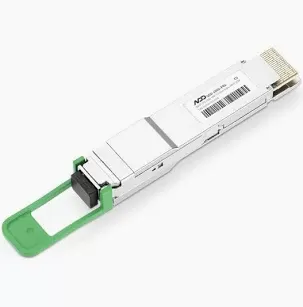
Everything you need to know about QSFP56 200G transceivers: SR4, DR4, FR4, and LR4 variants with specification comparison table. PAM4 modulation, QSFP28 backward compatibility, and optimal use cases for hyperscale server connectivity.
QSFP56 Transceiver: Bridging 100G and 400G with 200G PAM4
QSFP56 is the 200 Gigabit Ethernet evolution of the QSFP form factor, reusing the identical mechanical envelope and 38-pin connector of QSFP28 but doubling the per-lane data rate from 25 Gbps NRZ to 50 Gbps PAM4. This strategic design choice gives QSFP56 full backward compatibility with QSFP28 optics while delivering 200G in the same port footprint — a natural stepping stone between 100G and 400G for hyperscale data centers upgrading their server-facing links.
From NRZ to PAM4: The QSFP56 Speed Doubling
The core physics behind QSFP56 is straightforward: take the four-lane QSFP electrical interface and replace 25 Gbps NRZ signaling with 50 Gbps PAM4 signaling. Where NRZ encodes one bit per symbol (two voltage levels), PAM4 uses four voltage levels to encode two bits per symbol, effectively doubling throughput without increasing the baud rate. Each QSFP56 lane runs at 26.5625 Gbaud with PAM4 modulation, yielding 53.125 Gbps per lane — hence the "56" designation (4 × 56 Gbps ≈ 200G after FEC encoding overhead).
This lane-compatible approach means QSFP56 ports on switches and NICs can auto-negotiate down to QSFP28 speeds. A QSFP56 cage accepts a QSFP28 100G module seamlessly: the host detects the lower-speed module and switches to 25G NRZ per lane. Conversely, a QSFP56 200G module plugged into a QSFP28-only host will not function (the host lacks PAM4-capable SerDes), but the mechanical and electrical safety interlocks prevent damage. This graceful backward compatibility has made QSFP56 the default 200G form factor for top-of-rack switches connecting to 200G-capable servers and storage nodes.
Like its 400G QSFP-DD sibling, QSFP56 mandates RS-FEC (544,514) across all PAM4 lanes, adding roughly 6% overhead and yielding a net data rate of 200 Gbps from a raw line rate of ~212.5 Gbps. The FEC engine is embedded in the host ASIC; QSFP56 transceivers themselves are FEC-transparent but designed with the link budget to accommodate FEC-correctable BER floors.
All QSFP56 200G Variants at a Glance
| Variant | Standard / MSA | Lane Config | Wavelength | Fiber Type | Max Distance | Connector | Typical Power |
|---|---|---|---|---|---|---|---|
| QSFP56 SR4 | 200GBASE-SR4 (802.3cd) | 4×50G PAM4 | 850 nm | OM3/OM4 MMF | 70 m / 100 m | MPO-12 (8-fiber) | ≤4.0 W |
| QSFP56 DR4 | 200G DR4 (MSA) | 4×50G PAM4 | 1310 nm | SMF (G.652) | 500 m | MPO-12 (8-fiber) | ≤5.5 W |
| QSFP56 FR4 | 200G FR4 (MSA) | 4×50G PAM4 | CWDM4: 1271–1331 nm | SMF (G.652) | 2 km | Duplex LC | ≤6.0 W |
| QSFP56 LR4 | 200G LR4 (MSA) | 4×50G PAM4 | LAN-WDM: 1295–1310 nm | SMF (G.652) | 10 km | Duplex LC | ≤7.0 W |
SR4: 200G Over Multimode — Direct 100G Successor
The QSFP56 SR4 is the most widely deployed 200G transceiver for intra-rack and same-row connections. It maps four 50G PAM4 electrical lanes to four 850 nm VCSEL optical lanes over an 8-fiber MPO-12 ribbon cable — the exact same fiber infrastructure used for 100G QSFP28 SR4. This cabling continuity is one of QSFP56 SR4's strongest selling points: data centers with existing MPO-12 multimode trunks can upgrade from 100G to 200G by swapping transceivers at both ends, with zero changes to the passive fiber plant. Over OM4, it reaches 100 meters, covering typical ToR-to-server distances. VCSEL maturity keeps power below 4 W and per-unit costs competitive with high-volume 100G SR4 modules.
DR4: 500-Meter Single-Mode Parallel Optics
The QSFP56 DR4 variant extends the parallel-optics architecture to single-mode fiber at 1310 nm, delivering 200G over 500 meters on standard G.652 fiber. Four DFB or silicon-photonics transmitters drive four parallel SMF strands in an MPO-12 connector. DR4 is targeted at inter-row and cross-hall data center links that exceed the 100-meter multimode budget but don't justify the additional cost and complexity of wavelength-multiplexed FR4 optics. The 500-meter reach also makes DR4 suitable for campus distribution where building-to-building fiber distances are moderate.
FR4 and LR4: Duplex Single-Mode for Campus and Metro
For deployments constrained to duplex single-mode fiber pairs — the most common scenario outside the data center hall — QSFP56 FR4 and LR4 provide the solution. The FR4 variant wavelength-multiplexes four 50G PAM4 channels on the CWDM grid (1271, 1291, 1311, 1331 nm) into a duplex LC connector, achieving 2 km on standard SMF. It is the default choice for building-to-building campus links, where the fiber plant is almost always duplex LC single-mode, and 2 km covers virtually all campus topologies.
QSFP56 LR4 pushes to 10 km by adopting the LAN-WDM grid with cooled EML transmitters and APD receivers — the same proven technology used in 100G LR4 and 400G LR4 modules. The tighter wavelength spacing demands more precise temperature control and higher-performance optics, but the result is a 200G link spanning metro-area distances without mid-span amplification. For enterprises connecting two data centers or a corporate campus across a city, QSFP56 LR4 delivers ten times the reach of FR4 in the same duplex LC form factor.
QSFP56 in the 200G Ecosystem
QSFP56 occupies a deliberate niche in the data center speed hierarchy. It targets the server-access layer where 100G is becoming insufficient for next-generation NICs (such as NVIDIA ConnectX-7 and Intel E810 200G adapters) but 400G is overkill in cost and port utilization. A 200G QSFP56 ToR switch port connected to a 200G server NIC provides exactly the bandwidth that AI/ML training nodes, NVMe-oF storage targets, and high-frequency trading servers demand — without stranding unused capacity.
The form factor's backward compatibility with QSFP28 also makes it a low-risk upgrade path: operators can deploy QSFP56 switches today, populate ports with inexpensive 100G QSFP28 optics where 200G isn't needed, and selectively upgrade to 200G QSFP56 optics as server bandwidth requirements grow. This flexibility, combined with QSFP56's mechanical identity with the ubiquitous QSFP28, has cemented its role as the pragmatic 200G interconnect choice.
Last updated on July 08, 2026