
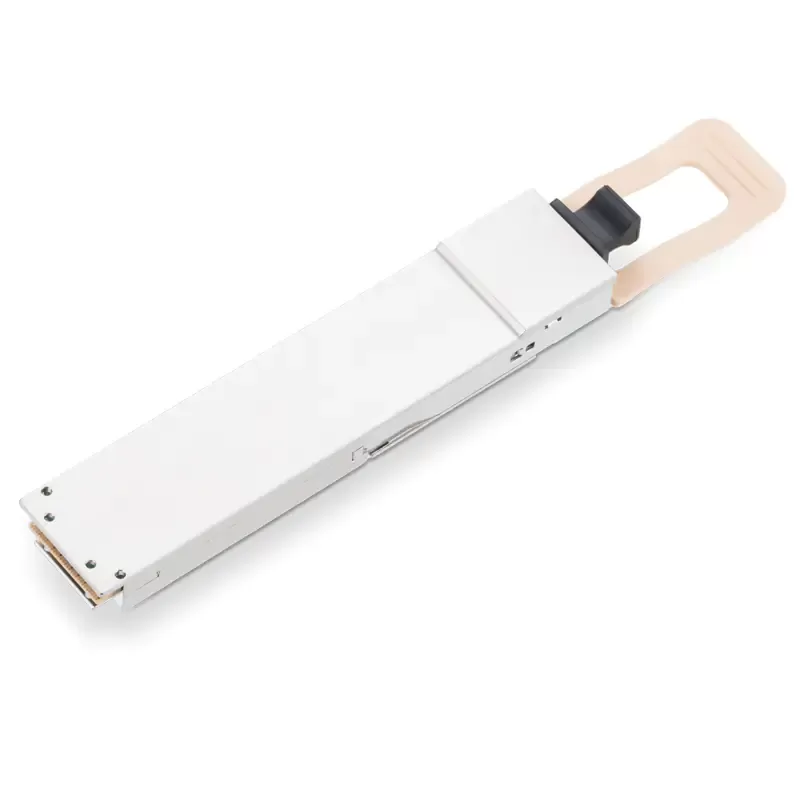
Complete QSFP-DD 400G transceiver reference covering SR8, DR4, FR4, and LR4 variants. Specification comparison table, PAM4 signaling, FEC requirements, and backward compatibility with QSFP28. Ideal for 400G data center upgrades.
QSFP-DD Transceiver: Doubling Density for the 400G Era
QSFP-DD (Quad Small Form-Factor Pluggable Double Density) is the industry's answer to 400 Gigabit Ethernet. By adding a second row of electrical contacts beneath the traditional QSFP edge connector, it doubles the lane count from four to eight while retaining full mechanical backward compatibility with QSFP28 and QSFP56 modules. This makes QSFP-DD the densest pluggable form factor standardized under the QSFP-DD MSA, delivering 400G in the same port pitch as legacy 100G platforms.
The Double-Density Architecture
The defining innovation of QSFP-DD is the 8-lane electrical interface. Instead of the four high-speed differential pairs in QSFP28, the QSFP-DD connector exposes eight lanes — each capable of running at 50 Gbps PAM4 (NRZ for backward-compatible modes) — for an aggregate 400 Gbps. The connector's second row of contacts sits directly below the first, preserving the same 18.35 mm cage width as QSFP28. A QSFP-DD cage accepts QSFP28 and QSFP56 modules natively: the legacy module simply mates with the upper row of contacts, while the lower row remains unconnected.
The electrical signaling paradigm shifts from the simple NRZ (non-return-to-zero) modulation used in QSFP28 to PAM4 (pulse-amplitude modulation with four levels), which encodes two bits per symbol. This allows each lane to carry 50 Gbps (2 × 25 Gbaud) rather than 25 Gbps, but at the cost of reduced signal-to-noise ratio. Forward error correction (FEC) — specifically RS-FEC (544,514) as defined in IEEE 802.3 clause 91 — is mandatory for all PAM4-based QSFP-DD links, adding approximately 6% overhead and correcting burst errors up to 15 symbols. The combination of PAM4 + FEC enables QSFP-DD to pack 400G into a form factor that can be deployed at the same port density as 100G QSFP28.
All QSFP-DD 400G Variants at a Glance
| Variant | IEEE Standard | Lane Config | Wavelength | Fiber Type | Max Distance | Connector | FEC Required |
|---|---|---|---|---|---|---|---|
| QSFP-DD SR8 | 400GBASE-SR8 (802.3cm) | 8×50G PAM4 | 850 nm | OM3/OM4 MMF | 70 m / 100 m | MPO-16 (16-fiber) | Yes (RS-FEC) |
| QSFP-DD DR4 | 400GBASE-DR4 (802.3bs) | 4×100G PAM4 | 1310 nm | SMF (G.652) | 500 m | MPO-12 (8-fiber) | Yes (RS-FEC) |
| QSFP-DD FR4 | 400GBASE-FR4 (802.3cu) | 4×100G PAM4 | CWDM4: 1271–1331 nm | SMF (G.652) | 2 km | Duplex LC | Yes (RS-FEC) |
| QSFP-DD LR4 | 400GBASE-LR4 (802.3cu) | 4×100G PAM4 | LAN-WDM: 1295–1310 nm | SMF (G.652) | 10 km | Duplex LC | Yes (RS-FEC) |
SR8: 400G Over Multimode Fiber
The QSFP-DD SR8 is the short-reach workhorse for intra-data-center 400G links. It maps all eight electrical lanes directly to eight parallel optical lanes — four VCSELs at 850 nm per direction, each modulated at 50 Gbps PAM4. This requires an MPO-16 connector with 16 fibers (8 TX, 8 RX), a shift from the MPO-12 used for 100G SR4. Over OM4 multimode fiber, the SR8 reaches 100 meters — sufficient for same-row ToR-to-leaf or leaf-to-spine connections in hyperscale fabrics. Power consumption typically stays under 8 W, and the VCSEL-based design benefits from mature, high-yield 850 nm manufacturing processes. For data centers with existing 8-fiber MPO-12 cabling, SR8 requires re-cabling to 16-fiber trunks; however, SR8-to-4×100G breakout configurations (using MPO-16 to 4×MPO-4 fan-out cables) are popular for connecting a single 400G QSFP-DD port to four 100G QSFP28 downlinks.
DR4: 500-Meter Single-Mode with Parallel Optics
400GBASE-DR4 takes a different architectural approach: instead of eight lanes, it uses only four optical lanes — each running at 100 Gbps PAM4 — over parallel single-mode fiber at 1310 nm. It employs four silicon-photonics or DFB-based transmitters coupled to an 8-fiber MPO-12 connector (4 TX + 4 RX). DR4 reaches 500 meters on standard G.652 single-mode fiber, making it ideal for inter-row and inter-hall data center links that exceed the 100-meter multimode limit. Because it uses fewer optical channels than SR8, the transceiver bill of materials can be simpler in some implementations, though the per-lane 100G PAM4 optics demand higher-bandwidth components. DR4 is also frequently used in breakout mode: one 400G DR4 port can serve four 100G DR/FR single-lambda links with appropriate fan-out cabling.
FR4 and LR4: Duplex Single-Mode from 2 km to 10 km
When the fiber plant is duplex LC single-mode — typical of campus, metro, and DCI (data center interconnect) deployments — the QSFP-DD FR4 and LR4 variants provide the answer. Both use four 100G PAM4 wavelengths multiplexed onto a single fiber pair via an internal CWDM or LAN-WDM MUX/DEMUX. The FR4 variant operates on the CWDM grid (1271, 1291, 1311, 1331 nm), reaching 2 km without amplification, making it the default choice for building-to-building campus links. LR4 shifts to the tighter LAN-WDM grid (centered around 1295–1310 nm) with cooled EML (electro-absorption modulated laser) transmitters and APD receivers, extending reach to 10 km — sufficient to connect geographically separated data centers within a metro region.
Both FR4 and LR4 maintain a standard duplex LC connector, preserving compatibility with the billions of LC-terminated single-mode patch panels already deployed. The internal multiplexing optics (thin-film filters or arrayed waveguide gratings) add cost relative to parallel-fiber designs, but the savings from using two fibers instead of eight or sixteen often dominate the total cost of ownership in campus and metro builds.
QSFP-DD in the 400G Ecosystem
QSFP-DD competes with the OSFP (Octal Small Form-Factor Pluggable) form factor, but QSFP-DD's backward compatibility with QSFP28 gives it a decisive advantage for operators upgrading existing 100G infrastructure. A QSFP-DD switch port can run a QSFP28 100G module today and a QSFP-DD 400G module tomorrow without changing the switch or the cage — only the optics and potentially the fiber plant. This investment protection, combined with the MSA's broad industry support (Cisco, Arista, Broadcom, Intel, Juniper, and others), has cemented QSFP-DD as the dominant 400G form factor in enterprise and cloud switching.
Looking beyond 400G, the QSFP-DD800 variant doubles the per-lane speed to 100 Gbps PAM4 (8 × 100G = 800G) using the same connector, demonstrating the form factor's headroom. As of 2025, QSFP-DD remains the platform of choice for 400G spine-leaf fabrics, high-performance computing interconnects, and the first wave of 800G deployments, with a mature ecosystem of switches, NICs, and test equipment.
Last updated on July 08, 2026