
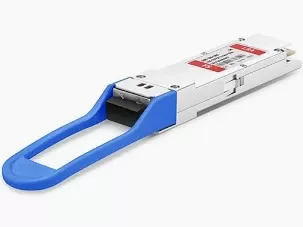
Complete guide to QSFP28 optical transceivers: 100G SR4, BiDi, PSM4, CWDM4, LR4, ER4, and AOC variants. Full spec comparison table, reach options from 100 m to 40 km. Trusted by cloud data centers worldwide.
QSFP28 Transceiver: The 100G Workhorse of Cloud Data Centers
QSFP28 (Quad Small Form-Factor Pluggable 28) is the dominant 100 Gigabit Ethernet optical transceiver form factor in modern data centers. Building on the QSFP+ legacy with four 25G NRZ electrical lanes, it delivers a full 100 Gbps in a compact, hot-pluggable package. From short-reach multimode fiber links to 40 km long-haul single-mode spans, QSFP28 covers every 100G reach requirement at the ToR-to-spine layer.
Why QSFP28 Dominates 100G Infrastructure
When IEEE 802.3bm standardized 100GBASE-SR4 in 2015, the QSFP28 form factor quickly eclipsed the bulkier CFP and CFP2 modules. Its key advantage is lane economics: rather than running 10 lanes of 10G (as in CFP), QSFP28 uses four 25 Gbps electrical lanes — each mapped to an optical lane — dramatically reducing connector complexity and cost. The 28 in the name refers to the total electrical bandwidth per lane: 4 × 28 Gbps (25G + FEC overhead).
QSFP28 modules consume under 3.5 W typically, support embedded management via the I²C-based CMIS or SFF-8636 digital diagnostic monitoring interface (DDM/DOM), and are hot-swappable without disrupting adjacent ports. The connector is the 38-pin QSFP edge card, with four high-speed differential TX/RX pairs. This simplicity, combined with massive hyperscale deployment, has driven per-unit costs below $100 for some SR4 variants, making 100G economically viable for mainstream enterprise adoption.
All QSFP28 Variants at a Glance
| Variant | IEEE Standard | Lane Config | Wavelength | Fiber Type | Max Distance | Connector | Typical Tx Power |
|---|---|---|---|---|---|---|---|
| QSFP28 SR4 | 100GBASE-SR4 | 4×25G NRZ | 850 nm | OM3/OM4 MMF | 70 m / 100 m | MPO-12 (8-fiber) | -8.4 to +2.4 dBm |
| QSFP28 SR4 BiDi | 100GBASE-SR4 BiDi | 4×25G NRZ | 850–870 nm, bi-directional | OM4 MMF | 70–100 m | Duplex LC | -4.0 to +5.0 dBm |
| QSFP28 PSM4 | 100G PSM4 (MSA) | 4×25G NRZ | 1310 nm | SMF (G.652) | 500 m–2 km | MPO-12 (8-fiber, APC) | -9.4 to +2.0 dBm |
| QSFP28 CWDM4 | 100G CWDM4 (MSA) | 4×25G NRZ | 1271–1331 nm (CWDM grid) | SMF (G.652) | 2 km | Duplex LC | -6.5 to +2.5 dBm |
| QSFP28 LR4 | 100GBASE-LR4 | 4×25G NRZ | LAN-WDM 1295–1310 nm | SMF (G.652) | 10 km | Duplex LC | -4.3 to +4.5 dBm |
| QSFP28 ER4 | 100GBASE-ER4 | 4×25G NRZ | LAN-WDM 1295–1310 nm | SMF (G.652) | 40 km | Duplex LC | -2.9 to +4.5 dBm |
| QSFP28 AOC | Vendor MSA | 4×25G NRZ (electrical) | 850 nm VCSEL | MMF (integrated cable) | 3–100 m | QSFP28 fixed cable | N/A (integrated) |
SR4 and BiDi: Short-Reach Multimode Options
The QSFP28 SR4 is the highest-volume 100G transceiver by a wide margin. It uses four parallel VCSELs at 850 nm, each modulated at 25.78 Gbps NRZ, and requires an 8-fiber MPO-12 ribbon cable (four fibers for TX, four for RX). Over OM4 multimode fiber, it reaches 100 meters — perfect for same-row ToR-to-server or ToR-to-spine interconnect within a data center hall. The VCSEL-based design keeps power consumption at roughly 2.5 W and enables low-cost manufacturing at scale.
A more recent innovation is the QSFP28 SR4 BiDi (bidirectional) variant. Rather than using eight fibers, BiDi optics multiplex two wavelengths per fiber in each direction, delivering full 100G over a standard duplex LC multimode pair. This is transformative for brownfield data centers with legacy LC cabling plants: operators can upgrade from 10G or 25G to 100G without re-cabling. The trade-off is slightly higher module cost and tighter link budget constraints, but the cabling savings often outweigh both.
PSM4: Parallel Single-Mode for Mid-Reach
The QSFP28 PSM4 (Parallel Single-Mode 4-lane) standard, driven by the PSM4 MSA, adapts the parallel-optics architecture of SR4 to single-mode fiber at 1310 nm. Four DFB lasers transmit over four parallel single-mode fibers in an MPO-12 trunk cable, achieving 500 meters on standard G.652 fiber and up to 2 km with engineered link budgets. PSM4 modules typically use an angled physical contact (APC) MPO connector to minimize back-reflection. They fill the gap between the 100 m limit of SR4 and the 2 km reach of CWDM4, often at a slightly higher cost due to DFB lasers, but without the mux/demux complexity of CWDM optics.
CWDM4, LR4, and ER4: Duplex Single-Mode for Longer Spans
When duplex LC fiber infrastructure is mandatory — common in campus and metro deployments — the QSFP28 CWDM4 is the go-to choice. It multiplexes four wavelengths on the coarse WDM grid (1271, 1291, 1311, and 1331 nm) onto a single fiber pair via an internal MUX/DEMUX, reaching 2 km without amplification or dispersion compensation. CWDM4 modules are ideal for inter-building links within a campus or between adjacent data center halls where a single duplex fiber pair must carry 100G.
For 10 km reach — the classic LR benchmark — QSFP28 LR4 uses the tighter LAN-WDM wavelength plan (1295.56, 1300.05, 1304.58, and 1309.14 nm), combined with cooled DML or EML lasers to maintain signal integrity over longer fiber spans. The ER4 variant extends this to 40 km by employing higher-output EML transmitters with APD-based receivers and semiconductor optical amplifiers (SOAs) in some implementations. Both LR4 and ER4 maintain the duplex LC interface, ensuring compatibility with existing single-mode fiber plants.
AOC: Integrated Active Optical Cables
For ultra-short in-rack and adjacent-rack links, QSFP28 Active Optical Cables (AOCs) integrate the optics and fiber permanently into a single assembly. This eliminates connector loss, provides factory-terminated performance, and typically costs less than two transceivers plus a patch cable. AOCs are available in lengths from 3 to 100 meters and are widely used in top-of-rack switch-to-server connections where the predictable, fixed-length environment justifies the non-removable cable design.
QSFP28 in the 100G Ecosystem
Beyond standalone modules, QSFP28 ports on modern switches and routers accept QSFP+ (40G) optics with automatic rate adaptation, and QSFP28 cages on QSFP-DD or QSFP56 systems provide backward compatibility. This interoperability ensures a smooth migration path from 40G to 100G to 200G and 400G. With millions of ports deployed globally, the QSFP28 ecosystem remains the most mature, cost-optimized 100G optical interconnect platform available — and it will continue to serve as the leaf-spine backbone of cloud data centers for years to come.
Last updated on July 08, 2026