
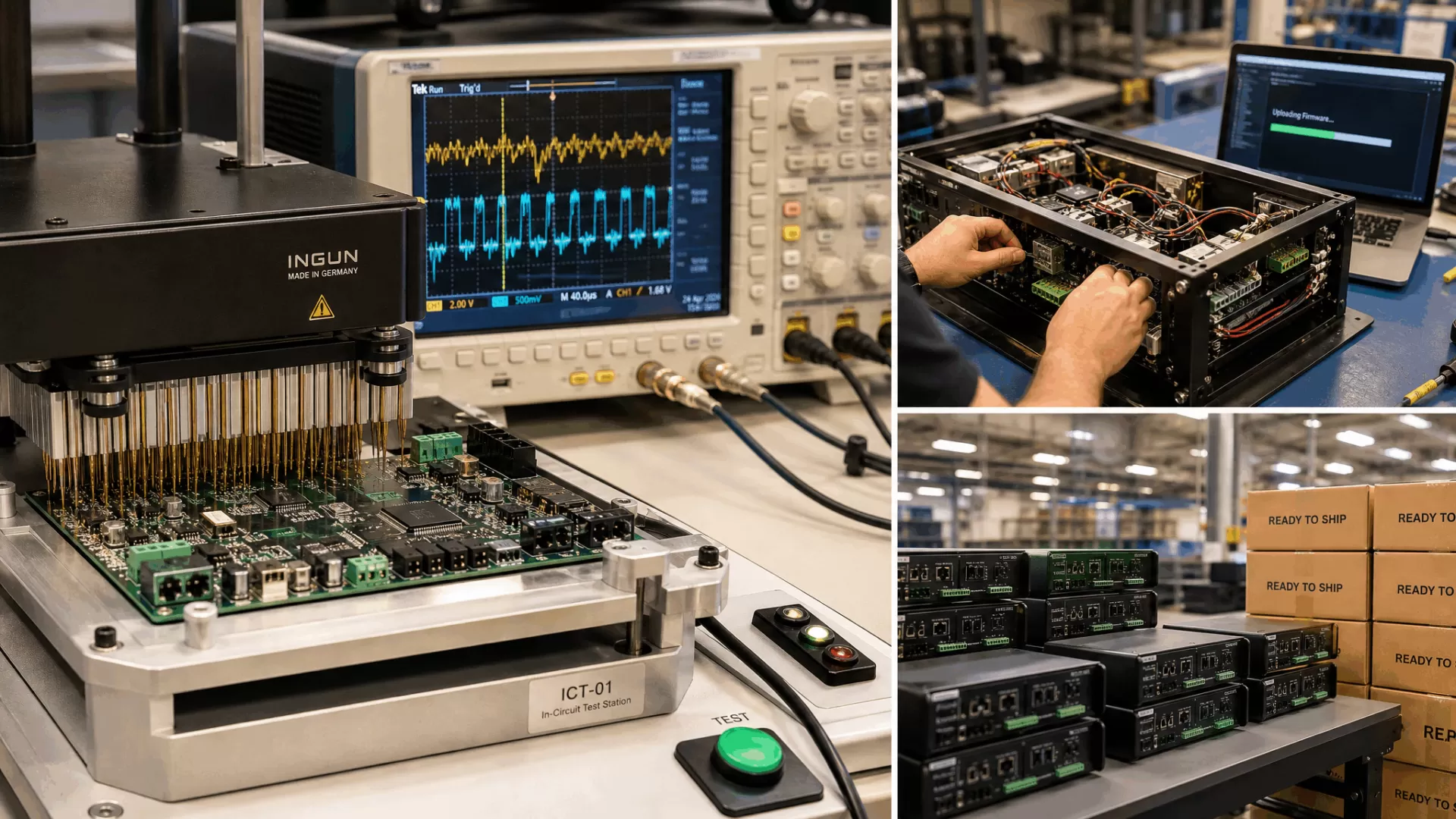
An assembled PCB that passes AOI and X-ray inspection is electrically intact — but whether it performs its intended function under real operating conditions remains unverified until functional testing is completed. A board with perfect solder joints can still fail due to a marginal component, a firmware mismatch, a timing race condition, or a parametric drift outside the design envelope. ADD Components closes this verification gap with a comprehensive test and systems-integration capability that spans bare-board testing, in-circuit test, custom functional test, and complete box-build assembly — delivering products that are tested, programmed, labelled, and ready to ship.
The Test Coverage Gap in Contract Assembly
Many PCB assembly providers offer only structural inspection — AOI and visual check — and ship boards with no electrical verification beyond a basic power-on smoke test. For simple LED driver boards this may be acceptable; for microcontroller-based products, power converters, communication modules, or multi-board systems, it is not. A board that powers up but runs firmware incorrectly, or oscillates outside its specified frequency range, or draws 20% more current than expected, represents a latent failure that structural inspection alone cannot catch.
The cost consequences escalate with each stage the defect travels undetected: finding a fault at bare-board test costs perhaps $0.50 per board; at functional test, $5; at system integration, $50; at end-customer deployment, $500 or more in warranty and logistics costs. The most economical point to catch a defect is as early as possible, with progressively comprehensive test coverage at each production stage.
ADD Components Test Capabilities
Flying Probe and In-Circuit Test (ICT)
For prototype and low-to-medium volume production, flying probe testers provide fixtureless electrical verification of every net on a bare or assembled PCB. Four to eight independently programmable probes move at high speed to contact test points, measuring resistance, capacitance, inductance, diode junctions, and continuity between any two points on the board. Flying probe testing requires no custom fixturing — test programmes are generated directly from the Gerber and netlist data — making it cost-effective for batch sizes from one to several hundred boards.
For higher-volume production, bed-of-nails ICT fixtures provide faster cycle times (typically 5 to 15 seconds per board) with comprehensive coverage of component values, orientation, shorts, opens, and basic functional blocks. ADD Components designs and sources ICT fixtures through our tooling partners, with fixture NRE costs typically ranging from $1,500 to $8,000 depending on board complexity and node count. We advise customers on the volume threshold at which ICT fixturing becomes cost-justified relative to flying probe on a per-board cost basis.
Custom Functional Test
Functional test verifies that the assembled PCB performs its intended operation under conditions that simulate real-world use. ADD Components develops custom functional test solutions based on the customer's test specification, which typically defines: power-up sequence and current draw, voltage rail tolerances, clock frequencies and signal integrity, communication interface functionality (UART, SPI, I2C, CAN, Ethernet, USB), analogue input/output accuracy, and firmware behavioural checks.
Test fixturing for functional test ranges from simple bed-of-nails interfaces with breakout connectors to fully enclosed automated test stations with microcontroller-based stimulus and measurement, data logging, and pass/fail indication. Our engineering team works from customer-provided test plans, schematics, and firmware to design and commission the test solution. Typical fixture development lead time is two to four weeks, depending on complexity. Once commissioned, the test fixture becomes a production asset: every board of that type runs through the same test sequence, producing a logged pass/fail result with measured values that form part of the quality record.
Burn-In and Environmental Stress Screening
For products destined for high-reliability applications, ADD Components offers accelerated burn-in testing. Assembled boards are operated under elevated temperature (typically 50°C to 70°C ambient) for a customer-specified duration — commonly 24 to 168 hours — to precipitate infant-mortality failures before shipment. Burn-in chambers are equipped with power cycling capability and continuous monitoring. Any board that fails during burn-in is quarantined for failure analysis and not shipped. This process is standard for military, aerospace, medical, and industrial control applications where early-life failure is unacceptable.
Box Build and System Integration
Beyond PCB-level test, ADD Components provides complete box-build assembly — the integration of tested PCBs into enclosures, along with all associated mechanical, electrical, and firmware elements required to produce a finished product. Box-build services include:
Mechanical assembly: PCB mounting into enclosures using standoffs, brackets, and fasteners; installation of fans, heat sinks, thermal interface materials, and shielding.
Cable harness and wiring: Fabrication and installation of custom cable assemblies, wire looms, and harnesses with connector termination, strain relief, and routing per assembly drawings.
Sub-assembly integration: Combining multiple PCBs, power supplies, displays, keypads, and peripheral modules into a single enclosure with internal interconnect.
Firmware loading and configuration: Programming microcontrollers, FPGAs, and memory devices with customer-supplied firmware images; serialisation, MAC address assignment, and configuration parameter setting.
Labelling and packaging: Application of product labels, serial-number barcodes, regulatory markings; final packaging in customer-specified retail or bulk packaging.
Final system test: Power-on and functional check of the fully assembled product before packaging, verifying that all sub-systems operate correctly as an integrated whole.
Test Strategy by Production Volume
| Volume | Recommended Test Approach | Typical Coverage |
|---|---|---|
| Prototype (1-50 pcs) | Flying probe + manual functional test | Netlist verification, basic power and function |
| Low-Medium (50-500 pcs) | Flying probe + semi-automated functional test fixture | Full netlist + full functional spec |
| Medium-High (500-5,000 pcs) | ICT fixture + automated functional test station | Component-level + functional + data-logged |
| High Volume (5,000+ pcs) | ICT + fully automated functional test + burn-in sampling | Full production ATE with statistical process control |
A Single Partner from BOM to Finished Product
The operational advantage of combining test and box build with component sourcing and PCB assembly under one provider is difficult to overstate. When procurement, assembly, test, and system integration are split across multiple vendors, responsibility for quality becomes diffuse. A field failure triggers a cascade of vendor investigations, each pointing at the other. ADD Components eliminates this fragmentation: we source the components, assemble the boards, test them, integrate them into enclosures, programme firmware, and ship finished product — all with a single point of accountability and a single quality record that traces from incoming component lot through to serialised final product.
For customers developing industrial controllers, IoT gateways, medical devices, test instrumentation, and communication equipment, this translates into reduced vendor-management overhead, shorter lead times, and measurably lower defect-escape rates. The product you receive has been verified at every stage — not just structurally, but functionally, under conditions that reflect how it will be used in the field.
Submit your BOM and Gerber files to info@addcomponents.hk for a PCBA quotation — typically within 24 hours.