
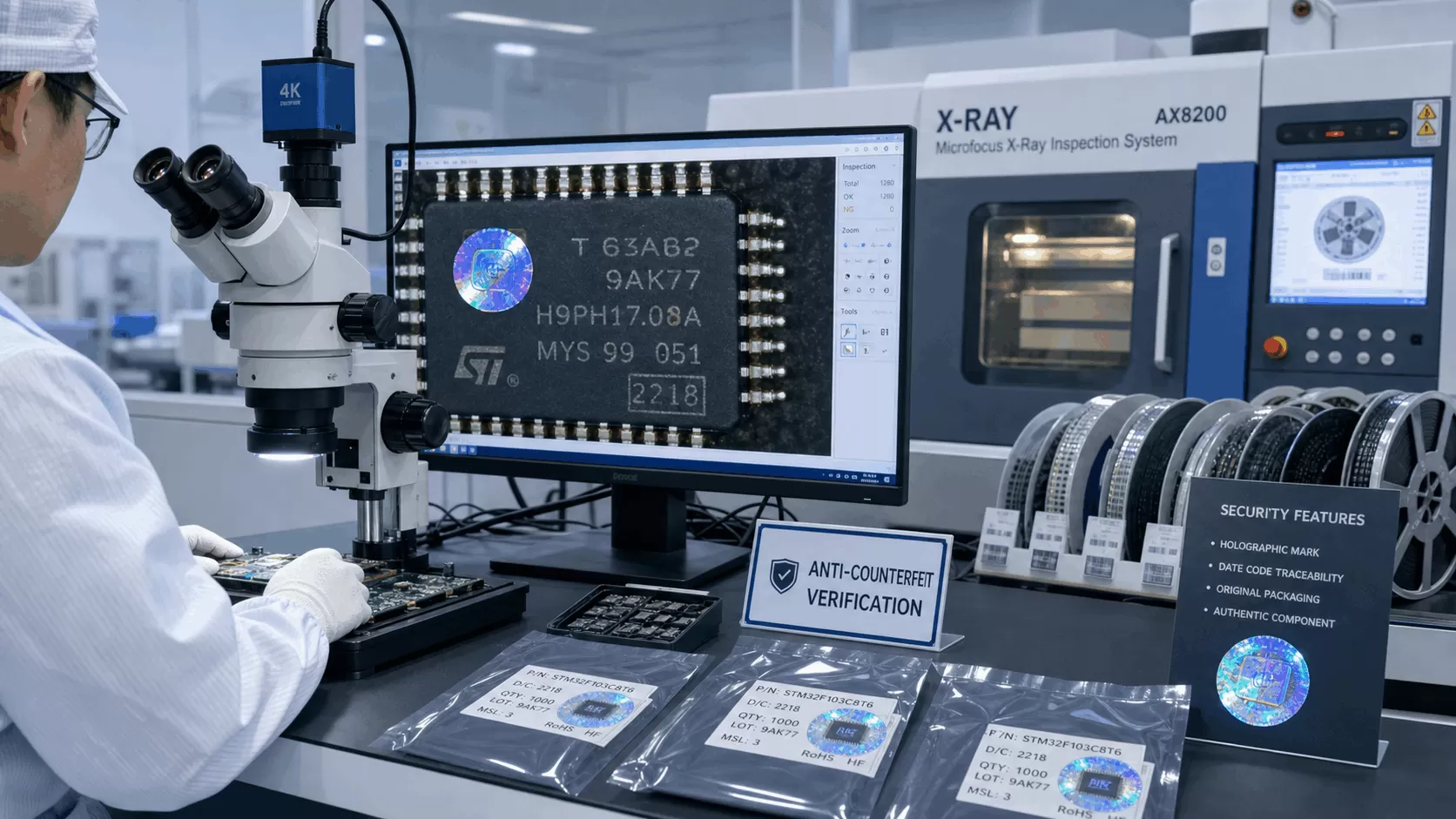
Counterfeit electronic components are not a hypothetical risk — they are an active, growing threat that costs the global electronics industry an estimated $5 billion annually. For procurement managers and production engineers, a single re-marked IC or substandard passive component entering the assembly line can result in field failures, warranty claims, regulatory non-compliance, and reputational damage that takes years to repair. The problem has escalated as supply chain disruptions push buyers toward non-franchised channels, where counterfeit penetration rates can exceed 10% in certain component categories.
ADD Components addresses this risk at its source with a structured incoming quality control programme that inspects every incoming reel, tray, and tube before components reach the SMT line. Our approach is not a sampling-based spot check — it is a systematic, multi-stage verification process designed to detect re-marked ICs, blacktopped packages, substandard passives, date-code anomalies, and traceability inconsistencies before they become production liabilities.
The Scale of the Counterfeit Problem
Counterfeit semiconductors typically fall into several categories: re-marked used parts pulled from e-waste and resurfaced, functional but misrepresented lower-grade parts sold as higher-specification equivalents, empty or non-functional packages, and cloned components from unlicensed fabs. Sophisticated counterfeiters now use laser re-marking, chemical blacktopping, and lead-frame refinishing techniques that can defeat casual visual inspection. Meanwhile, passive components such as MLCCs and chip resistors are subject to specification fraud — parts rated for 85°C sold as 125°C automotive-grade equivalents, or lower-capacitance parts re-labeled to meet a BOM requirement they cannot actually satisfy.
Industry databases such as ERAI and GIDEP track thousands of counterfeit incident reports annually, yet the majority of counterfeit parts are never reported because failures are often attributed to design issues or assembly defects rather than component fraud. This creates a systematic undercount that masks the true scope of the problem.
ADD Components Incoming Inspection Protocol
Every component lot received at our facility undergoes a four-stage incoming QC process before acceptance into inventory for production use:
Stage 1: External Visual and Packaging Inspection
All incoming reels, trays, and tubes are examined for packaging integrity, label consistency, and manufacturer-standard markings. We verify that reel dimensions, carrier-tape pocket geometry, humidity indicator card (HIC) status, and moisture-barrier bag seals conform to the original manufacturer's specifications. Packaging anomalies — non-standard reel flanges, incorrect embossed-tape depth, missing or altered label fields — are flagged immediately and the affected lot is quarantined pending further investigation.
Stage 2: Microscopic Component-Level Inspection
Components are inspected under 20x to 200x stereo microscopes with digital image capture. Inspectors examine package surfaces for evidence of blacktopping (a chemical coating applied to obscure original markings), sanding marks, inconsistent surface texture, and mold-mark irregularities. Pin-one indicators, laser-etch quality, and font consistency are compared against manufacturer reference samples and known-good parts from our verified inventory. Re-marked parts frequently exhibit subtle inconsistencies in marking depth, character spacing, or logo geometry that are detectable only at high magnification.
Stage 3: X-Ray and Electrical Verification
Suspected or high-risk components undergo 2D X-ray imaging to compare internal lead-frame geometry, die-attach placement, and wire-bond patterns against manufacturer reference data. Counterfeit parts often have different internal structures from genuine components — wrong die sizes, missing bond wires, or alternative lead-frame designs. For ICs, we perform curve-trace analysis (IV characteristic testing) on a sample basis to verify that pin-to-pin electrical characteristics match the manufacturer's published specifications. Passive components are tested for capacitance, resistance, and tolerance using LCR meters calibrated to 0.1% accuracy.
Stage 4: Date-Code and Traceability Audit
Date codes and lot codes are cross-referenced against manufacturer date-code formats, factory-of-origin records, and known discontinuation timelines. Components bearing date codes that post-date the manufacturer's documented EOL notification, or date codes from fabrication facilities not associated with the part number, are rejected. Full traceability documentation — including certificate of conformance, country of origin, and supply chain custody records — is maintained for every accepted lot.
Component Categories Under Enhanced Surveillance
| Component Category | Counterfeit Risk | ADD Inspection Focus |
|---|---|---|
| FPGAs (Xilinx, Altera/Intel) | Very High | X-ray die verification, package marking analysis, JTAG ID check |
| Microcontrollers (STM32, Microchip) | High | Package texture, marking consistency, IV curve trace |
| Analog ICs (TI, ADI) | High | Pin-1 marking, date-code format, electrical parametrics |
| MOSFETs / Power Transistors | Moderate-High | Lead-frame X-ray, RDS(on) spot test |
| MLCC Capacitors | Moderate | Capacitance measurement, dimensional verification, termination quality |
| Memory ICs (DRAM, NAND Flash) | High | Speed-grade verification, marking depth analysis, X-ray |
| Optocouplers / Isolators | Moderate | CTR measurement, package marking, manufacturer lot trace |
Why Component-Level QC Matters Before Assembly
Detecting a counterfeit component after it has been soldered onto a PCB multiplies the cost of remediation by a factor of 10 to 50. Reworking a single BGA on a high-layer-count board can cost hundreds of dollars in labour and risk pad damage; a field failure triggered by a counterfeit IC that passes initial power-on testing may not manifest until the product has been deployed for months. By intercepting non-conforming components before they reach the pick-and-place machine, ADD Components eliminates these downstream costs and protects the integrity of every assembly we build.
Our incoming QC data also feeds back into supplier qualification: we maintain a database of lot-acceptance rates by vendor, part number, and date-code range, enabling us to route procurement toward the most reliable supply channels. When anomalies are detected, we collaborate with ERAI and industry partners to document and report the findings, contributing to broader industry efforts against counterfeit infiltration.
For buyers sourcing from multiple channels — particularly in markets where franchised distribution is unavailable or allocation-restricted — ADD Components provides a single point of accountability. Components arrive, get inspected, get assembled, and get shipped. There is no gap between procurement and production where counterfeit risk can enter undetected.
Submit your BOM and Gerber files to info@addcomponents.hk for a PCBA quotation — typically within 24 hours.