
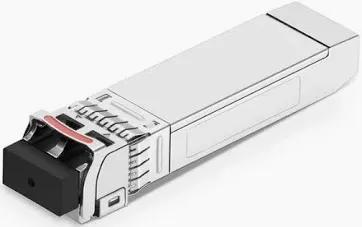
Complete SFP+ 10G optical transceiver guide covering all variants: SR (850 nm MMF, 300 m OM3/400 m OM4), LR (1310 nm SMF, 10 km), ER (1550 nm, 40 km), ZR (80 km), LRM for legacy MMF, 8G/16G Fibre Channel, 10G CPRI, and OTU2. Specification tables, application guidance, and procurement insights. ADD Components Hong Kong.
SFP+ Transceiver: The Definitive Guide to 10-Gigabit Pluggable Optics
The SFP+ (Enhanced Small Form-Factor Pluggable) transceiver is the dominant 10 Gbps optical form factor across data centers, enterprise networks, carrier transport, and storage networks. Physically identical in footprint to the original SFP, the SFP+ cage supports 10 Gigabit Ethernet (IEEE 802.3ae), 8G/16G Fibre Channel (ANSI INCITS), CPRI radio access, and OTU2/OTU2e transport — all within the same compact LC-connector form factor that has shipped in the hundreds of millions of ports. With SR for intra-rack and intra-building links, LR for campus and metro, and ER/ZR for long-haul without amplification, SFP+ covers every distance tier that a pluggable 10G optic can realistically address.
All SFP+ Variants: Specification Comparison
The SFP+ family spans four primary reach variants for 10 Gigabit Ethernet, plus Fibre Channel and CPRI speed grades. The table below captures all major commercially deployed SFP+ transceiver types.
| Variant | IEEE / Application | Speed | Wavelength | Fiber | Max Reach | TX Power (dBm) | RX Sensitivity (dBm) |
|---|---|---|---|---|---|---|---|
| SR | 10GBASE-SR | 10.3125 Gbps | 850 nm (VCSEL) | MMF (OM3/OM4) | 300 m (OM3); 400 m (OM4) | –7.3 to –1 | –11.1 (OM3); –11.1 (OM4) |
| LR | 10GBASE-LR | 10.3125 Gbps | 1310 nm (DFB) | SMF (OS1/OS2) | 10 km | –8.2 to +0.5 | –14.4 |
| ER | 10GBASE-ER | 10.3125 Gbps | 1550 nm (DFB, cooled) | SMF (OS1/OS2) | 40 km | –4.7 to +4 | –15.8 |
| ZR | Proprietary 10G-ZR | 10.3125 Gbps | 1550 nm (DFB, cooled) | SMF (OS1/OS2) | 80 km | 0 to +4 | –23 (APD) |
| LRM | 10GBASE-LRM | 10.3125 Gbps | 1310 nm (FP) | Legacy MMF (FDDI-grade 62.5 µm) | 220 m | –6.5 to +0.5 | –6.5 (with EDC on host) |
| 8G FC | FC-PI-4 (8GFC) | 8.5 Gbps | 850 nm (VCSEL) | MMF (OM2/OM3/OM4) | 50 m (OM2); 150 m (OM3); 190 m (OM4) | –8.2 to –1.3 | –13.0 |
| 16G FC | FC-PI-5 (16GFC) | 14.025 Gbps | 850 nm (VCSEL) | MMF (OM3/OM4) | 35 m (OM3); 100 m (OM4) | –7.8 to –1.3 | –11.1 |
| 10G CPRI (Option 7) | CPRI v6.1 / v7.0 | 9.8304 Gbps | 1310 nm (DFB) | SMF | 10 km (standard); 20 km (extended) | –8.2 to +0.5 | –14.4 |
| OTU2 | ITU-T G.959.1 | 10.709 Gbps | 1310 nm or 1550 nm | SMF | 10–80 km | Varies by reach class | Varies by reach class |
| BiDi SFP+ | Proprietary 10G-BiDi | 10.3125 Gbps | TX 1270 / RX 1330 nm (paired) | SMF (single strand) | 10–40 km | –6 to +0.5 | –14.4 to –19 |
10GBASE-SR: The Data Center Dominant
10GBASE-SR is the highest-volume SFP+ variant by a wide margin, accounting for roughly 60–70% of all 10G SFP+ modules shipped. It uses an 850 nm VCSEL transmitter achieving 10.3125 Gbps over laser-optimized multi-mode fiber with simple direct modulation — no external modulator, no TEC cooler, minimal power consumption (typically sub-1 W). On OM3 fiber (2,000 MHz·km effective modal bandwidth), the IEEE specification guarantees 300 meters; on OM4 (4,700 MHz·km EMB), reach extends to 400 meters. In practice, high-quality SR modules with well-controlled spectral width and extinction ratio often achieve 500+ meters on OM4. Within a data center, SR covers every intra-rack and intra-row connection, plus most inter-row links within the same hall. The SR transceiver's low cost, low latency, and low power make it the default choice where multi-mode fiber infrastructure exists. For greenfield data center builds, the economics break in favor of deploying OM4 MMF and equipping every 10G port with SR — the fiber is more expensive than OS2 single-mode, but the transceivers are 50–70% cheaper than LR, and the aggregate savings at scale (thousands of ports) far outweigh the fiber premium.
10GBASE-LR: Campus and Metro Workhorse
10GBASE-LR shifts to 1310 nm single-mode operation with a directly modulated DFB laser, delivering 10 km reach on standard G.652 OS2 fiber with a link budget of approximately 6.2 dB. At 10 Gbps, chromatic dispersion at 1310 nm is near zero on G.652 fiber, so dispersion-induced eye closure is not a limiting factor — the reach is bounded purely by attenuation. In enterprise networks, LR connects buildings across a campus, links distribution switches to a centralized core, and provides fiber uplinks from access-layer stacks in IDF closets. In carrier networks, LR serves as the access-side 10G interface for cell-site routers, DSLAM backhaul, and business Ethernet demarcation. LR modules typically consume less than 1.5 W and use an uncooled DFB laser, keeping the bill of materials simple and reliability high. Extended-reach LR variants (sometimes labeled LR+) push the link budget to 9–10 dB by raising launch power and improving receiver sensitivity, achieving 20–25 km on clean fiber plant without inline amplification.
10GBASE-ER and ZR: Long-Haul Without Amplification
For spans that exceed the 10 km LR ceiling, 10GBASE-ER (40 km) and the proprietary 10G-ZR (80 km) fill the gap between short-reach pluggable optics and full WDM transport systems. ER operates at 1550 nm — the attenuation minimum of silica fiber — using a cooled EML (electro-absorption modulated laser) or externally modulated DFB with launch power between –4.7 and +4 dBm. The IEEE 802.3ae ER specification defines a link budget of approximately 11 dB, corresponding to 40 km on OS2 fiber with margin. ZR pushes further by pairing a higher-power 1550 nm DFB laser (0 to +4 dBm) with an APD-based receiver achieving –23 dBm sensitivity, for a link budget around 27 dB — sufficient for 80 km without inline amplification. At 80 km, chromatic dispersion at 1550 nm (~1,360 ps/nm total) must be managed: ZR-rated modules designed for full 80 km operation incorporate dispersion-tolerant transmitter design or specify operation with dispersion-compensating fiber (DCF) at the receiver. Both ER and ZR consume 1.5–2.5 W due to TEC cooling requirements, and the higher-cost laser/receiver components push unit pricing 3–5× above LR equivalents.
10GBASE-LRM: Bridging Legacy Multi-Mode Infrastructure
A specialized SFP+ variant, 10GBASE-LRM (Long Reach Multimode) addresses a specific brownfield challenge: delivering 10 Gbps over the vast installed base of legacy FDDI-grade 62.5 µm multi-mode fiber that was widely deployed in the 1990s and early 2000s. Standard 10GBASE-SR cannot operate over 62.5 µm FDDI fiber due to severe differential mode delay (DMD). LRM uses a 1310 nm FP transmitter with controlled launch conditions and relies on electronic dispersion compensation (EDC) implemented in the host switch ASIC or PHY to recover the severely distorted signal at the receiver. It achieves 220 meters on legacy 62.5 µm MMF — sufficient to re-use existing riser and horizontal cabling in older buildings without pulling new fiber. LRM was ratified in IEEE 802.3aq and remains relevant for enterprise and government facilities with entrenched multi-mode plant where re-cabling is cost-prohibitive or logistically impossible.
Fibre Channel SFP+: 8GFC and 16GFC for Storage Networks
The SFP+ form factor is the dominant 8G and 16G Fibre Channel optical interface in storage area networks (SANs). 8GFC SFP+ modules operate at 8.5 Gbps using 850 nm VCSEL transmitters, reaching 50 meters on OM2, 150 meters on OM3, and 190 meters on OM4. 16GFC doubles the line rate to 14.025 Gbps, reducing reach to 35 meters on OM3 and 100 meters on OM4. Fibre Channel optics must meet tighter jitter budgets and lower bit-error-rate thresholds (BER < 10⁻¹²) than Ethernet, reflecting the lossless, deterministic nature of storage traffic. While 32GFC SFP28 modules have entered the market, the installed base of 8GFC and 16GFC SFP+ ports in Brocade, Cisco MDS, and QLogic/HPE SAN directors remains enormous, and SFP+ FC module procurement continues as a recurring operational requirement for storage infrastructure teams.
10G CPRI and OTU2: Telecom-Specific SFP+ Applications
In mobile network infrastructure, CPRI Option 7 (9.8304 Gbps) SFP+ modules carry digitized RF between the baseband unit and remote radio head in distributed 4G LTE and early 5G NR base station architectures. These modules typically use 1310 nm DFB lasers for 10–20 km single-mode spans and must meet strict latency (< 5 µs round-trip) and jitter (< 0.5 ps RMS) requirements to maintain air-interface timing integrity. OTU2 SFP+ modules, operating at 10.709 Gbps per ITU-T G.959.1, serve as client-side optics in OTN (Optical Transport Network) equipment — connecting router 10GE LAN-PHY ports to OTN muxponders and transponders in carrier core and metro transport networks. OTU2 SFP+ modules incorporate G.709 framing with FEC (forward error correction) overhead, distinguishing them from native 10GE LAN-PHY SFPs.
Deployment Volume Dynamics: SR for Data Center, LR for Everywhere Else
The global SFP+ market splits roughly 60:30 between SR and LR variants, with ER, ZR, LRM, and Fibre Channel collectively making up the remaining 10%. This reflects the underlying economics: in data centers, where port counts run into the tens of thousands per facility, the ~50% unit-cost savings of SR over LR translates to millions of dollars in aggregate optics spend. In campus and carrier networks, where fiber distances routinely exceed the 300–400 meter MMF ceiling, LR is non-negotiable. The market has stabilized around these two variants as the dominant volume platforms, with ER/ZR serving long-reach niche requirements that cannot justify full WDM transport systems. For procurement teams, the most important differentiators among suppliers are MSA compliance, OEM platform coding accuracy, DDM implementation quality, and batch-to-batch consistency in optical performance parameters — particularly extinction ratio and receiver sensitivity margin at end-of-life conditions.
Last updated on July 08, 2026